Clinical research
Understand how studies are designed and how protocol requirements guide data collection.


Every clinical study begins with a scientific question. Answering it requires reliable data, sound statistical decisions and careful programming. For students and graduates in life sciences, biotechnology, pharmacy and related disciplines, this is where scientific knowledge connects with careers in clinical research and data analytics.


KITEL Talentworks
Clinical Data Analytics & Career Learning
Discover how a vaccine study planning error connects life sciences, biostatistics and SAS programming—and what students can learn from a case like this.
For students and graduates in life sciences, biotechnology, pharmacy, microbiology, biochemistry and related disciplines.
Every clinical study begins with a scientific question. Answering it requires reliable data, sound statistical decisions and careful programming.
For students and graduates in life sciences, biotechnology, pharmacy and related disciplines, this is where scientific knowledge connects with opportunities in clinical research and data analytics.
Clinical studies generate information about participants, treatments, laboratory assessments, adverse events and outcomes. Professionals organize these records, check their quality, program analyses and prepare results for scientific review.
This case explores how KITE-Ai Technologies identified a sample size planning error in a vaccine study. It introduces the thinking behind the work—from understanding the objective to checking assumptions and interpreting results.
Understand how studies are designed and how protocol requirements guide data collection.
Learn why complete, consistent and traceable records are essential before analysis.
Transform records into analysis datasets, summaries, tables and reviewable outputs.
How many participants are needed to answer a vaccine study’s primary question?
During an independent review of a paediatric vaccine non-inferiority study, KITE-Ai Technologies identified an error in a sample size calculation prepared by another service provider.
Too few evaluable participants could leave the study without its planned statistical power. An unnecessarily large recruitment target could increase procedures, site workloads, time and costs.
KITE-Ai revisited the underlying assumptions and recruitment requirement. It also recommended the following method for the planned confidence interval analysis.
Used to construct a confidence interval for the difference between two independent response proportions.
The review addressed both sample size planning and alignment with the study’s non-inferiority objective.
The correction helped avoid recruitment beyond the corrected statistical requirement.
It helped avoid study activity associated with unnecessary recruitment.
It helped reduce avoidable operational expenditure while maintaining agreed statistical requirements.
These are qualitative benefits reported for the case. No numerical savings or participant-level information are presented.
Understanding the vocabulary is the first step toward understanding the work.
One important distinction: choosing a confidence interval method and verifying sample size are connected tasks. Changing the method alone does not prove that fewer participants are sufficient. The revised design still needs an appropriate power assessment.
A learning version can use simulated or de-identified training data to develop the skills behind the analysis.
Identify the treatment comparison, endpoint and information needed to answer the scientific question.
Transform records into structured datasets for the planned summaries.
Connect participant counts and response proportions with uncertainty and interpretation.
Support an output with traceable rules, checks and clear communication.
These activities are illustrative. Assignment scope, statistical depth, tools and project availability depend on the selected program.
Vaccine studies may focus on antibody responses. Oncology studies may examine tumour response and survival. Respiratory studies may track symptoms and exacerbations. Each introduces different endpoints and data requirements.
Explore response proportions, antibody assessments, vaccination dates and safety follow-up.
Understand response assessments, event dates and follow-up information.
Explore repeated assessments, symptom measures and event-based questions.
KITE-Ai’s broader therapeutic expertise includes:
Partner expertise provides industry context; it does not mean every learner receives a project in every listed area.
KITEL Talentworks offers learning pathways in clinical trial data analytics, SAS programming, clinical research, clinical data management and pharmacovigilance.
KITE-Ai Technologies is KITEL’s strategic project-delivery partner. Its industry context supports guided learning exercises that connect classroom concepts with practical questions.
Responsibilities vary by employer and seniority. These examples can help you identify your interests.
Prepares clinical datasets, programs study summaries and supports output validation using SAS.
Reviews clinical information, identifies data issues and prepares summaries for study teams.
Builds and checks programs for clinical data processing, reporting and analysis workflows.
Applies statistical methods, interprets outputs and contributes to analysis and reporting.
Eligibility, responsibilities and compensation depend on qualifications, experience, technical ability and employer requirements.
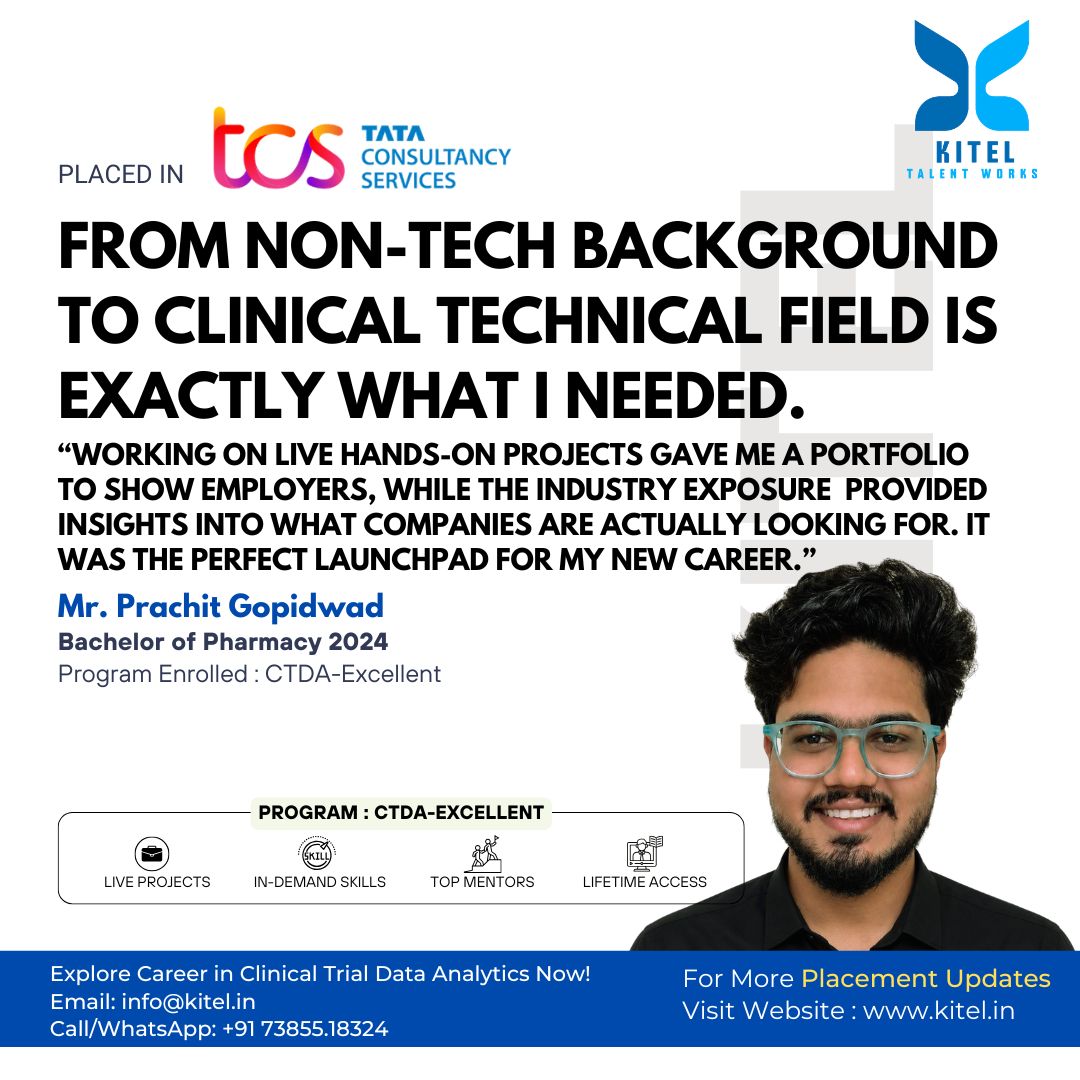
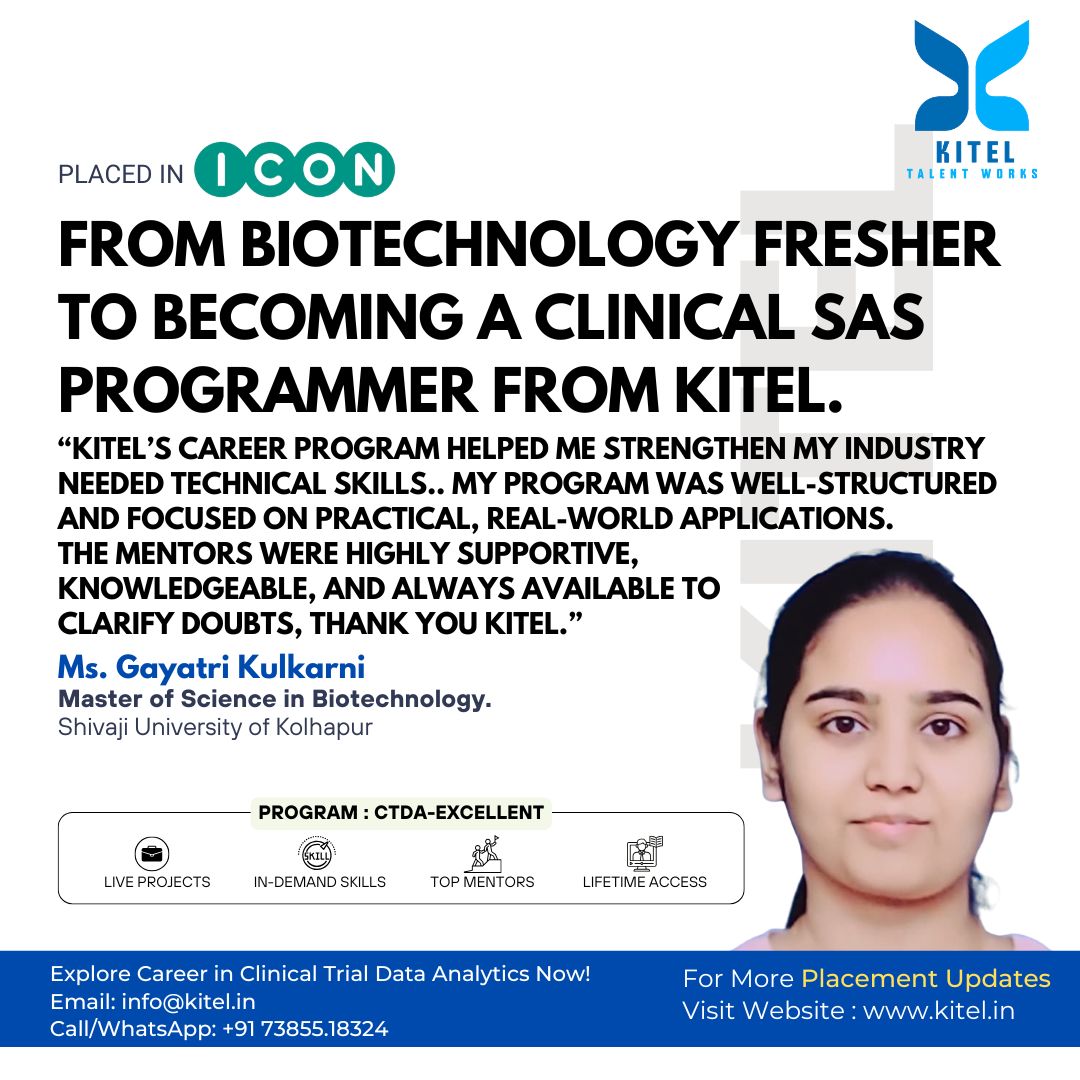
KITEL trainees have progressed into SAS and clinical programming roles at TCS. Published alumni stories also feature professionals working at Medpace, IQVIA, Cognizant, ICON and Novo Nordisk.
These are individual alumni outcomes. Employer names do not imply endorsement, a recruitment partnership or guaranteed employment.
Yes. Scientific knowledge can help you understand clinical endpoints, laboratory information and study questions. Ask KITEL which pathway fits your background.
You do not need to understand every concept in this case before exploring the field. Ask about prerequisites, foundation modules and the statistical depth of your program.
This case illustrates industry reasoning. Assignments may use simulated or de-identified material and depend on the program and project availability.
SAS provides tools to process and analyse data. Clinical knowledge helps you understand the records, apply appropriate rules and explain the output.
Individual outcomes depend on program terms, eligibility, performance, interviews and employer requirements. Discuss written program terms with KITEL before enrolling.
Explore how SAS, clinical knowledge and guided projects can fit into your career preparation.
When you enquire, share your qualification, graduation year and whether you are interested in programming, clinical research, data management or pharmacovigilance.

Batch Starting, Speak to our Team